

Snow Mold on Michigan Lawns: What It Is and How to Fix It
You walk outside this week, look down at your lawn, and see circular patches of gray or pinkish matted grass staring back at you. Before you start planning a full reseed, take a breath. It's snow mold, and in most cases, your lawn will be just fine.
What You Need to Know Right Now
- Snow mold is a fungal lawn disease that appears when snow melts, not a sign of dead grass
- Gray snow mold usually resolves with light raking; pink snow mold may need reseeding in damaged areas
- The right spring fertilization program speeds recovery and helps prevent the same damage next winter
Every March in Southeast Michigan, the snow pulls back, revealing what winter left behind. For many homeowners in Macomb and Oakland Counties, what they find are gray or pink circular patches, matted flat, with grass that looks bleached or webbed together. In our 46 years caring for Michigan lawns, snow mold is one of the first calls we get every spring, right around this time of year.
The good news is that most snow mold damage looks a lot worse than it actually is. Understanding what you're dealing with and knowing the difference between the two types makes all the difference in how quickly your lawn bounces back.
What Is Snow Mold on a Lawn?
Snow mold is a fungal lawn disease that develops under snow cover and becomes visible only after the snow melts. It's extremely common in Michigan, particularly in areas like Macomb County, Oakland County, Shelby Township, and Sterling Heights, where winters regularly bring extended snow cover on ground that hasn't fully frozen. When wet, mild conditions create that ideal window of cold-but-not-frozen soil under a blanket of snow, the fungus gets to work.
According to Michigan State University Extension, both gray and pink snow mold were very active during heavy snow cover winters, and in most cases, the fungus blights the leaf blades without actually killing the turfgrass plant. That's an important distinction, and we'll get into why it matters when deciding how to treat it.
Why Does Snow Mold Show Up in Michigan Lawns?
Snow mold develops when two conditions line up: snow that sits for an extended period, and soil that wasn't fully frozen when the snow fell. The fungus thrives in the cold, moist environment beneath the snowpack, where temperatures range from 30 to 55°F, according to MSU Extension's turfgrass disease research. That temperature range is almost a perfect description of a typical Michigan November or early December.
Two different fungi cause what homeowners know as snow mold. Gray snow mold is caused by Typhula species (Typhula blight), and it tends to be worse in winters when snow falls on unfrozen turf. Pink snow mold is caused by Microdochium patch (formerly called Fusarium patch), and it can actually develop without any snow cover at all, during extended stretches of cool, wet weather.
Snow piles left near driveways and sidewalks are another major trigger. Wherever snow is pushed into corners and piles, it lingers longer than the surrounding lawn, keeping that area cold and wet well into spring. If you're noticing damage concentrated near where your plow or snowblower piled snow, that's exactly why. We also commonly see it near downspouts, shaded areas, and low spots where water pools. For more on what your lawn goes through during the cold months, our post on dormant season lawn care covers the full picture of winter stress on turf.
What Does Snow Mold Look Like on a Lawn?
Snow mold is pretty easy to spot once you know what you're looking for. The patches appear suddenly as snow pulls back, and they tend to cluster in the same predictable spots year after year. Here's what to watch for:
- Circular or roughly circular patches, ranging from 2 inches up to 2 or 3 feet across
- Grass inside the patch looks straw-colored, bleached, or matted flat
- A grayish-white cottony fuzz visible at the edges (gray mold) or a pinkish to salmon-colored tinge (pink mold)
- Grass blades that look webbed together or compressed in a mat
- Patches concentrated near snow pile zones, shaded spots, or low-lying areas of the yard
- Damage is only visible after the snow has fully melted, not during winter
If you're seeing these signs in your yard right now in Sterling Heights, Troy, Rochester Hills, or the surrounding area, you're almost certainly looking at snow mold. The patches may look alarming, especially if they're covering a significant portion of the lawn, but the first question to ask is which type you're dealing with.
Gray Snow Mold vs. Pink Snow Mold: What's the Difference?
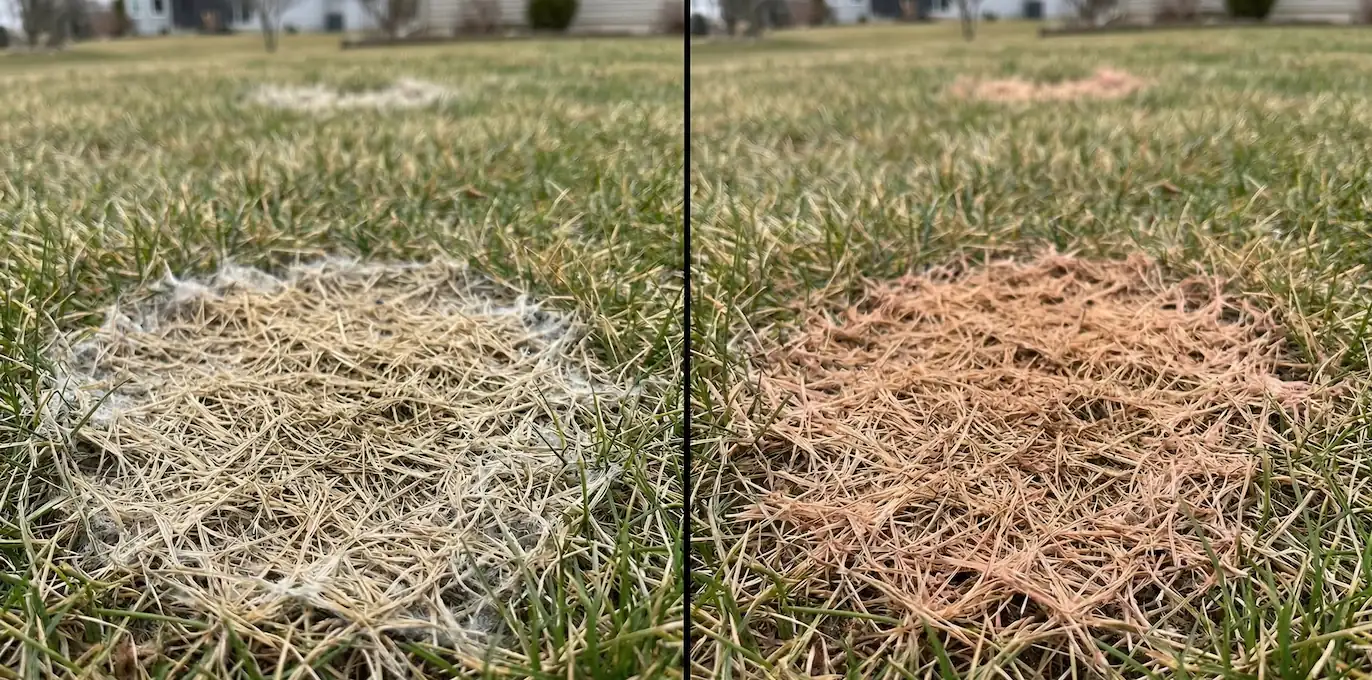
Gray snow mold (Typhula blight) damages only the grass blades, leaving the roots and crown alive, so the lawn typically recovers on its own as temperatures warm. Pink snow mold (Microdochium patch) can kill the plant's roots and crown, slowing recovery and sometimes requiring reseeding in heavily damaged areas. Identifying which type you have shapes everything about your next step.
Look closely at the patches. Gray mold tends to produce a grayish-white fuzz at the margins of the damaged areas, and the inside of the patch is bleached or straw-colored. Pink mold has that distinctive reddish-brown or salmon tone, and the damaged turf often appears more thoroughly killed rather than just matted.
We've seen gray mold resolve on its own in most Michigan lawns once daytime temperatures consistently push above 45°F and the turf dries out. Pink mold is a different situation, because even after the visible damage heals, bare spots may remain where the crown was killed. Those areas often need help filling in.
Should You Rake Snow Mold, or Wait for It to Go Away?
This is one of the most common questions we hear in spring. The short answer: light raking helps, heavy raking hurts, and doing nothing slows recovery.

MSU Extension recommends using a leaf rake, not a garden rake, to gently loosen the matted grass in affected areas. According to MSU Extension turfgrass specialist Kevin Frank, raking removes some of the dead, blighted leaf blades and improves airflow into the turf, accelerating drying and speeding recovery as temperatures warm. Focus on the worst-hit areas rather than raking the entire lawn.
What doesn't help:
- Applying fungicide after the mold is already visible. Fungicides for snow mold only work as a preventive treatment applied before snowfall in the fall. Spraying in spring after the damage is done won't reverse it.
- Ignoring the matted patches entirely. The compressed, wet mat of grass blades traps moisture at the surface and can significantly slow recovery.
- Raking too aggressively. The turf is weak, and the crowns may be vulnerable. Hard raking with a metal tine rake can pull out grass that would otherwise recover.
For gray snow mold, gentle raking and patience are usually all it takes. For pink mold with visible bare spots, the recovery picture is different, and that's where professional help may be worth considering.
When Does Snow Mold Need Professional Treatment?
Most cases of gray snow mold in Michigan lawns don't require professional intervention beyond a well-timed spring fertilization. But there are situations where calling in a lawn care company early pays off significantly.
If you're seeing bare patches, not just matted grass but actual dead areas where nothing is growing, that's a sign the crown may have been killed by pink snow mold. Those areas won't fill back in on their own quickly, and they're vulnerable to crabgrass and other weeds moving in before your turf can recover. Aeration and overseeding in spring can help those patches recover, and for existing Dynamic Lawn & Landscape customers, this is a service we can build into your recovery plan.
Our spring program is also specifically designed to support turf recovering from exactly this kind of winter stress. Round 1 starts in late March with granular fertilizer and pre-emergent crabgrass control, timed to push healthy new growth just as the damaged turf is trying to come back. Round 2 uses biosolids to support turf health and reduce conditions that favor fungal disease. Together, they give recovering grass the best chance to fill in before weeds can take advantage of weak or bare spots.
If you're seeing significant bare patches after snow mold, our lawn care services in Michigan can help you put together a recovery plan before the growing season gets ahead of you.
Not sure if the damage you're seeing is snow mold or something else? It's worth having a professional eye on it. Grub damage, vole tunneling, and other spring lawn problems can look similar but require very different treatment. Our post on grub control and lawn damage can help you rule out some of those other causes.
How Do You Prevent Snow Mold from Coming Back Next Year?
Snow mold prevention is mostly about what you do in the fall, before the first snow. The conditions that favor fungal growth, long snow cover on wet, dense turf, can be reduced significantly with some simple end-of-season habits.
- Mow at 2.5 to 3 inches going into winter. Tall grass left unmowed at the end of the season mats down under snow and creates the exact microenvironment where mold thrives.
- Clear leaves before the first snow. A layer of leaves left over the lawn going into winter smothers turf, traps moisture, and creates ideal conditions for fungal growth.
- Stay on schedule with fall fertilizer. Our Round 6 winterizer application builds root strength and helps turf harden off properly before dormancy. Skipping it leaves the grass more vulnerable going into the cold months.
- Spread snow piles instead of concentrating them. When you pile snow in the same corner or along the same fence line every year, you're setting that spot up for repeat damage. Spread it out when possible.
- Avoid heavy nitrogen fertilizer late in the season. Lush, actively growing turf going into winter is more susceptible to snow mold. Fertilization timing matters.
- Aerate in the fall to reduce thatch. Thick thatch holds moisture and provides a habitat for fungal spores. Fall aeration helps reduce that buildup and improves drainage.
Let Dynamic Lawn & Landscape Handle the Full Recovery Arc
After 46 years working with homeowners across Sterling Heights, Macomb, Shelby Township, Troy, Rochester Hills, and Washington Township, we've seen snow mold in every form Michigan winters can throw at it. What we've found is that the lawns that bounce back fastest are almost always those on a consistent program, with properly timed spring fertilization, fall prep, and disease management when needed.
Our lawn fertilization and weed control program, available in Silver, Gold, and Platinum packages, is built around the full-season schedule that supports a healthy turf through every stage, including recovery from a rough winter. We're rated 4.8 stars on Google by 298 homeowners across Southeast Michigan, and we're members of the Michigan Green Industry Association and NALP.
Get Ahead of Snow Mold Damage Before the Growing Season Starts
If your Michigan lawn is showing snow mold damage right now, March is the best window to act. Round 1 applications start in late March, and getting on the schedule early means your turf gets the support it needs right when recovery begins, not two months after the fact.
Get a free lawn care quote today and let us put together a snow mold recovery and prevention plan for your Michigan lawn before the growing season gets away from you.
Sources
- Frank, Kevin. "Spring Lawn Care Tips for the Do-It Yourselfers." MSU Extension Gardening in Michigan, Michigan State University, 31 Mar. 2020, www.canr.msu.edu/news/spring_lawn_care_tips_the_red_light_green_light_version.
- Frank, Kevin. "Winter Damage to Lawns: Molds, Moles and Voles." MSU Extension, Michigan State University, www.canr.msu.edu/news/winter_damage_to_lawns_molds_moles_and_voles.
- "Gray Snow Mold." MSU Integrated Pest Management, Michigan State University, www.canr.msu.edu/ipm/diseases/gray-snow-mold.